
Tablets remain the dominant oral dosage form because they combine accurate dosing, very high stability and acceptance, and cost-efficient, high-throughput manufacturing. Tablet coating or film coating further expands this platform by adding functional performance (e.g., enteric protection, modified release), stability (light/moisture barrier), and patient-centric attributes (taste masking, smoother swallowing, visual identification).
Why coating uniformity matters (and what it is not)
As coating functions become more complex, e.g., multi-layer systems, combination products, or individualized dosing concepts, uniformity becomes a critical quality requirement. Variations in coating thickness can translate into variability in release, taste masking, or barrier performance; QbD-based approaches (Quality-by-design) have been shown to improve coating uniformity using structured experimentation and analytics.
Uniformity is commonly quantified as RSD (relative standard deviation) of coating thickness or coating mass. Importantly, color difference (ΔE) is not equivalent to coating uniformity; ΔE indicates perceptible color differences and should not be used as a substitute for thickness/mass uniformity. High ΔE values describe a noticeable color difference.
Measuring what matters: beyond weight gain
In practice, coating amount is often tracked by weight gain, but recent research emphasizes that coating thickness and density can be more physically meaningful attributes for predicting performance (e.g., hydration/dissolution behavior) than weight gain alone - highlighting the value of deeper process understanding and suitable analytics. In development and scale-up, PAT concepts (e.g., spectroscopic and imaging approaches) support faster learning cycles and more reliable control strategies.
Equipment design as a lever for speed, flexibility, and efficiency
While formulation and operating parameters are central, coater geometry and air handling can significantly expand the feasible operating windowA larger effective spray area enables the use of more nozzles and higher total spray rates, which can shorten process times versus conventional short-drum designs. So, process-time reductions up to ~40% for its extended-drum concept compared with short-drum coaters (L/D < 1) can be realized, attributed to higher spray rates and expanded spray area.
To reduce spray loss and variability, it is important to direct process air into the tablet bed to improve heat and mass transfer, while avoiding direct impingement on the spray nozzles. This will help to minimize spray drying and related waste.
Process control, energy-efficient drying, and reproducible cleaning for higher plant availability
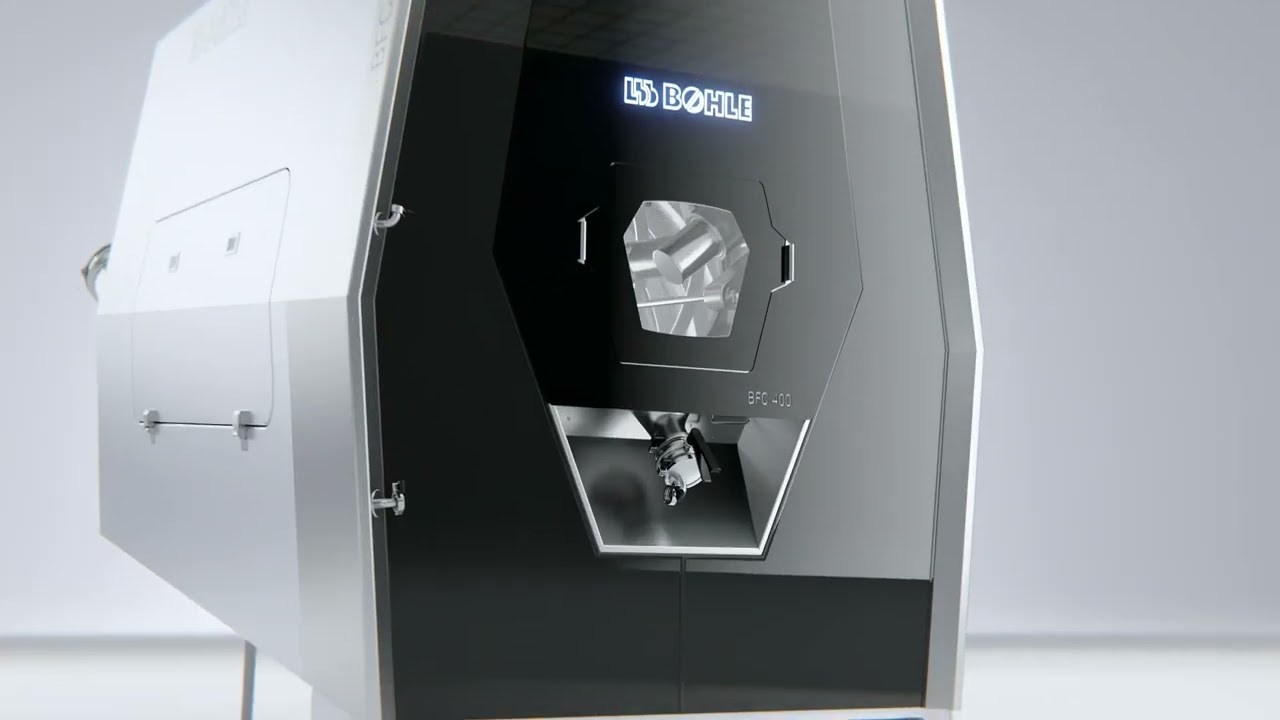
L.B. Bohle's large-scale production tablet coaters have established themselves in the market and are recognized as technologically advanced.
Digitalization and automation are becoming increasingly important in daily production. Against this backdrop, the importance of modern, digitally supported plant concepts is growing. An optimized control system that visualizes the process, such as iFix, can contribute significantly to this. Convenient monitoring, structured alarm and trend management, and consistent display of process-relevant variables make operation less prone to error. Deviations are detected earlier, and corrective measures can be implemented more effectively. This is particularly relevant in practice because tablet coating is usually carried out within a narrow operating window, where over-wetting (e.g. tablet twinning) and over-drying (e.g. spray drying, rough films and lower transfer efficiency) can directly affect product quality.
In addition, the ability to empty completely, quickly and gently is an underestimated factor in terms of quality and efficiency. Mechanisms such as reverse rotation, integrated mixing spirals and a tiltable design support rapid product discharge with minimal mechanical stress. This reduces residual quantities and shortens cleaning times, improving reproducibility between campaigns, particularly in multi-product environments where short changeover times and defined cleaning limits are crucial.
Cleaning is often the main factor limiting overall equipment effectiveness (OEE). Optimized, fully automated cleaning with shorter cycles addresses this bottleneck precisely by reducing downtime, improving cleaning reproducibility, and minimizing the need for manual intervention. This has two immediate effects: Firstly, plant availability increases while product quality remains the same. Secondly, the risk of operator error is reduced because cleaning steps are standardized and traceable. Meanwhile, sustainability and energy efficiency are becoming increasingly important: integrated energy monitoring provides transparency regarding the energy requirements of individual process phases, and optional heat recovery in the process airflow reduces the energy input required for drying. This means lower operating costs and a better balance sheet in terms of CO₂ reduction for companies, without compromising drying performance or process stability.
Conclusion
The role of tablet coating has evolved from an aesthetic finishing step to a critical unit operation that can affect product performance, stability and patient acceptance. As formulations become more functional, incorporating multi-layer architectures, combination products and tailored release profiles, the ability to deliver robust coating uniformity becomes essential. This requires a holistic view of the process, as uniformity is governed not by a single parameter, but by the tightly coupled interaction of mixing, spraying and drying, supported by analytics that accurately reflect coating quality.

